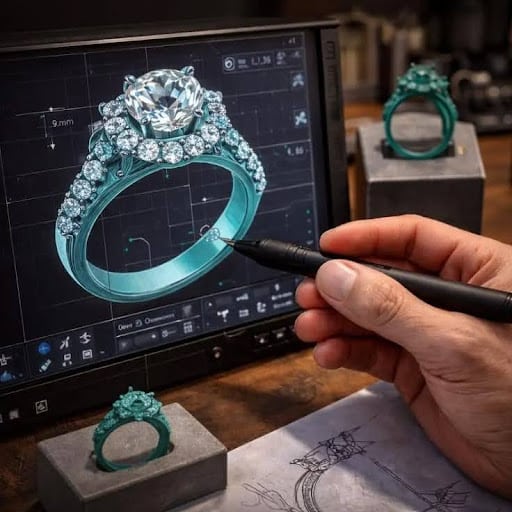
The jewellery industry has evolved significantly over the past decade. Traditional hand sketching and manual manufacturing techniques are now complemented by advanced digital technologies that improve precision, efficiency, and creativity. Among these innovations, CAD jewellery designing has emerged as one of the most valuable skills for aspiring jewellery professionals.
Computer-Aided Design (CAD) allows designers to create detailed 2D and 3D jewellery models before production begins. From engagement rings and necklaces to intricate bracelets and luxury collections, CAD technology helps designers visualise ideas with exceptional accuracy while reducing production errors and costs.
As the global jewellery market embraces digital transformation, CAD jewellery designing has become a sought-after skill for jewellery designers, manufacturers, retailers, and entrepreneurs. Whether you plan to work for a leading jewellery brand or launch your own business, learning CAD can significantly enhance your career prospects.
In this guide, you’ll learn what CAD jewellery designing is, why it’s considered a future skill, the software used, career opportunities, benefits, challenges, and practical tips to help you build a successful career.
What Is CAD Jewellery Designing?
CAD jewellery designing is the process of creating jewellery using Computer-Aided Design software. Instead of relying solely on hand-drawn sketches, designers use specialised software to build precise digital models that can be viewed from every angle.
These digital models are then used for:
- 3D rendering
- Prototype creation
- Wax model production
- Manufacturing
- Client presentations
- Product customization
CAD bridges creativity and technology, enabling designers to produce jewellery that is both visually stunning and technically accurate.
Why CAD Jewellery Designing Is the Future
1. Growing Demand for Digital Jewellery Design
Jewellery brands and manufacturers are increasingly adopting digital workflows to improve productivity and reduce production time.
With CAD, designers can:
- Create complex designs faster
- Modify designs instantly
- Produce accurate manufacturing files
- Reduce material waste
As technology becomes an industry standard, CAD skills are becoming essential rather than optional.
2. Faster Product Development
Traditional jewellery design often requires multiple sketches and physical prototypes before production.
CAD software speeds up the process by allowing designers to:
- Edit designs quickly
- Test multiple variations
- View realistic 3D models
- Prepare production-ready files
This results in shorter production cycles and faster product launches.
3. Higher Design Accuracy
Precision is critical in jewellery manufacturing.
CAD software enables designers to create accurate measurements for:
- Stone settings
- Ring sizes
- Metal thickness
- Prong placement
- Structural balance
Greater accuracy reduces costly manufacturing mistakes.
Popular CAD Jewellery Designing Software
Professional jewellery designers use various CAD programs depending on project requirements.
Some of the most popular software includes:
1. Rhino
Widely used for creating detailed 3D jewellery models with flexibility and precision.
2. MatrixGold
A specialised jewellery CAD software designed specifically for jewellery professionals.
3. JewelCAD
Known for its user-friendly interface and jewellery-focused features.
4. AutoCAD
Useful for technical drawings and precise engineering-based jewellery designs.
Learning one or more of these applications increases employability across the jewellery industry.
Skills You Learn in CAD Jewellery Designing
A professional CAD jewellery designing course helps students develop both creative and technical skills.
1. 3D Jewellery Modelling
Students learn how to transform sketches into realistic three-dimensional models.
2. Digital Rendering
Rendering creates photorealistic images that showcase jewellery before manufacturing.
3. Stone Setting Design
CAD allows precise positioning of diamonds and gemstones.
4. Manufacturing Preparation
Designers learn to prepare files suitable for casting, production, and 3D printing.
5. Design Modification
Digital models can be updated quickly based on customer feedback without recreating the entire design.
Benefits of Learning CAD Jewellery Designing
1. Better Career Opportunities
CAD designers are in demand across:
- Jewellery manufacturing companies
- Luxury jewellery brands
- Design studios
- Export houses
- E-commerce jewellery businesses
Employers increasingly prefer candidates with CAD expertise.
2. Improved Creativity
CAD software allows designers to experiment with shapes, textures, and intricate details that are difficult to achieve through traditional sketching alone.
It encourages innovation while maintaining production accuracy.
3. Supports Custom Jewellery Design
Today’s customers increasingly request personalised jewellery.
CAD enables designers to create:
- Engagement rings
- Wedding jewellery
- Name pendants
- Initial jewellery
- Customized luxury pieces
This capability adds significant value to both designers and businesses.
4. Integration with 3D Printing
Modern jewellery production frequently combines CAD with 3D printing.
Benefits include:
- Faster prototypes
- Better precision
- Reduced production costs
- Faster customer approvals
Designers familiar with both technologies have a competitive advantage.
Industries Hiring CAD Jewellery Designers
Professionals with CAD skills can work in multiple sectors.
Popular career options include:
- CAD Jewellery Designer
- Product Designer
- Jewellery Manufacturer
- Freelance Jewellery Designer
- Luxury Jewellery Brand Designer
- Jewellery Consultant
- Design Studio Specialist
- Jewellery Entrepreneur
The demand for digital design expertise continues to grow in both domestic and international markets.
Challenges of CAD Jewellery Designing
1. Learning Specialised Software
CAD software offers powerful features, but beginners may need time and consistent practice to master them.
Joining a structured training program can accelerate the learning process.
2. Keeping Up with Technology
Software updates and new design technologies are introduced regularly.
Successful designers continue learning throughout their careers to stay industry-ready.
3. Balancing Creativity and Technical Precision
While CAD improves accuracy, creativity remains essential.
The best jewellery designers combine artistic vision with technical expertise to produce designs that are both beautiful and practical.
Practical Tips for Beginners
1. Master Jewellery Design Fundamentals
Before learning CAD, understand:
- Design principles
- Jewellery anatomy
- Metal properties
- Gemstone basics
Strong fundamentals improve digital design quality.
2. Practice Every Day
Regular practice helps improve:
- Speed
- Accuracy
- Creativity
- Software confidence
Small daily projects build long-term expertise.
3. Build a Professional Portfolio
Include:
- Hand sketches
- CAD models
- Photorealistic renderings
- 3D printable files
A strong portfolio showcases both artistic and technical abilities.
4. Learn Industry Trends
Stay updated on:
- Modern jewellery styles
- Sustainable jewellery
- Lab-grown diamonds
- Luxury collections
- Digital manufacturing
Industry awareness improves employability.
Future Scope of CAD Jewellery Designing
The future of jewellery design in CAD is exceptionally promising. Between 2026 and beyond, technology will continue transforming jewellery production through:
- Artificial Intelligence-assisted design
- Advanced 3D printing
- Virtual product visualisation
- Cloud-based collaboration
- Digital customization
- Sustainable manufacturing
As consumers increasingly demand personalised jewellery and brands seek faster production methods, CAD designers will play an increasingly important role.
Professionals who combine creativity with digital expertise will enjoy excellent career opportunities in India and global markets.
Final Thoughts
CAD jewellery designing is no longer just an additional skill—it’s becoming a core requirement in the modern jewellery industry. By combining creativity, precision, and technology, CAD empowers designers to produce innovative, accurate, and production-ready jewellery designs.
Whether you aspire to work with luxury jewellery brands, manufacturing companies, or to build your own jewellery business, investing in CAD skills can significantly improve your career prospects.
The jewellery industry is moving toward digital transformation, and designers who embrace CAD today will be well-prepared for the opportunities of tomorrow.
FAQs
1. What is CAD jewellery designing?
CAD jewellery designing is the process of creating digital 2D and 3D jewellery models using specialised computer software for design, visualisation, and manufacturing.
2. Which software is commonly used for CAD jewellery designing?
Popular software includes Rhino, MatrixGold, JewelCAD, and AutoCAD.
3. Is CAD jewellery designing a good career?
Yes. As jewellery manufacturers increasingly adopt digital technology, skilled CAD designers are in high demand across design studios, luxury brands, and manufacturing companies.
4. Do I need drawing skills before learning CAD?
Basic sketching skills are helpful, but many CAD courses teach students how to convert ideas into digital models even if they have limited drawing experience.
5. Can I start my own jewellery business after learning CAD?
Yes. CAD skills make it easier to create customised jewellery, build a professional portfolio, work with manufacturers, and launch your own jewellery brand.
Future-Proof Your Jewellery Design Career with IFJD
At IFJD, students gain hands-on training in CAD jewellery designing, jewellery sketching, gemology, and modern manufacturing techniques. With experienced faculty, industry-standard software, practical workshops, and portfolio development support, IFJD prepares aspiring designers for successful careers in today’s technology-driven jewellery industry. Join IFJD and develop the digital design skills that leading jewellery brands and manufacturers are looking for.