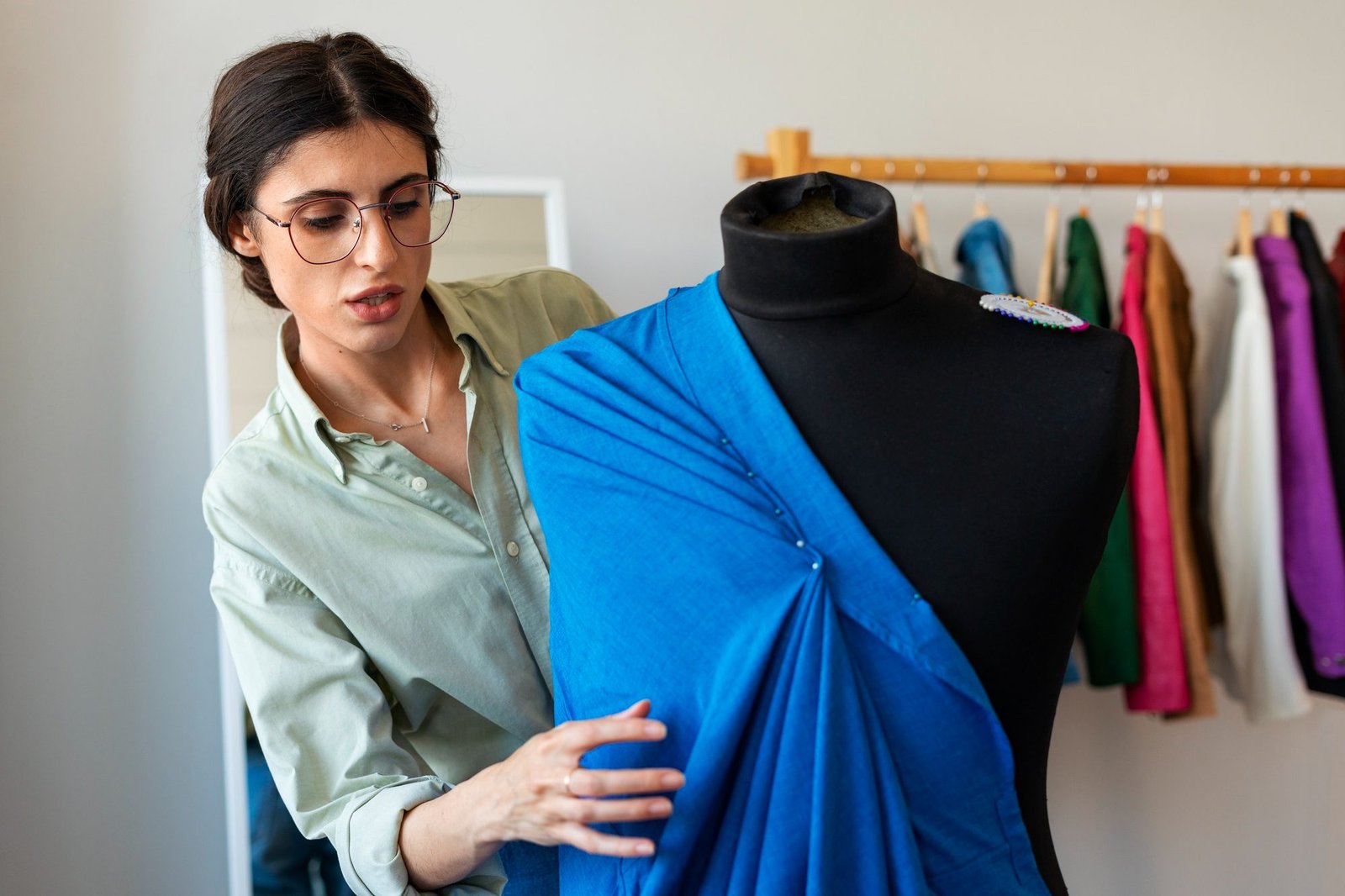
Fashion design is not limited to sketching garments on paper. At some point, designers need to understand how fabric behaves around the human body and how a two-dimensional material can become a three-dimensional garment. This is where fashion draping techniques become essential in fashion design education.
Fashion draping is a three-dimensional pattern-making and design method in which students position, pin, shape, and manipulate fabric directly on a dress form. Unlike flat pattern making, which begins on paper, draping allows students to see how fabric responds to the body’s contours, gravity, grain, tension, folds, and volume while developing a design.
For fashion design students, mastering draping is not simply about learning where to place pins. It requires an understanding of fabric grain, balance, proportion, fit, ease, silhouette, darts, pleats, gathers, and three-dimensional form. With practice, draping can help designers translate creative ideas into workable garment patterns and develop a stronger understanding of construction.
What Is Fashion Draping?
Fashion draping is the process of manipulating fabric directly on a dress form to develop a garment shape or pattern. The completed drape can then be marked, removed, refined, and transferred into a flat pattern for garment construction.
The technique is particularly useful when developing garments with:
- Complex silhouettes
- Soft or fluid shapes
- Draped necklines
- Cowl effects
- Pleats and tucks
- Asymmetrical details
- Sculptural forms
- Bias-cut designs
- Couture-inspired construction
Draping does not replace flat pattern making. Instead, both methods are complementary. Flat pattern making can provide precision and repeatability, while draping allows designers to explore form directly on a three-dimensional body shape.
Why Are Fashion Draping Techniques Important for Students?
Learning draping allows students to understand clothing from a different perspective.
A fashion illustration may show what a garment should look like, but draping reveals whether the idea actually works in fabric.
1. Draping Helps Students Understand Fabric Behaviour
Fabric does not behave like a drawing. It bends, stretches, folds, falls, resists movement, and responds differently depending on its grain.
By manipulating fabric on a dress form, students can observe these characteristics directly.
2. Draping Improves Understanding of Fit
Draping allows students to see where fabric pulls, collapses, wrinkles, or creates excess volume. These observations can improve their understanding of body contours and garment balance.
3. Draping Encourages Creative Experimentation
Instead of beginning with a predetermined paper pattern, students can manipulate fabric and discover unexpected silhouettes.
4. Draping Connects Design With Construction
The process helps students understand how creative decisions affect seams, darts, grainlines, ease, and final garment construction.
IFJD’s fashion design course includes advanced pattern making, draping, garment construction, and fabric application as part of its practical fashion education approach.
Essential Tools for Fashion Draping
Before practising fashion draping techniques, students should understand the basic tools involved.
1. Dress Form
A dress form provides the three-dimensional surface on which fabric is manipulated. It should represent the body size and proportions relevant to the intended garment.
2. Muslin
Muslin is commonly used for initial draping because it is relatively inexpensive and easy to mark and manipulate. For designs involving very fluid fabrics, however, students should understand that muslin may not behave exactly like the final fabric.
3. Dressmaking Pins
Sharp, suitable pins are required to secure fabric to the form and establish seams, darts, folds, and other design features.
4. Measuring Tape
A measuring tape helps students check proportions, lengths, and measurements during the draping process.
5. Marking Tools
Chalk, pencils, or suitable fabric markers can be used to mark seamlines, darts, style lines, grainlines, and other construction details.
6. Style Tape
Style tape or narrow ribbon can be used to establish important body and design lines on the dress form, such as the centre front, centre back, bust line, waistline, and hip line.
7. Scissors and Pattern Paper
After the drape is completed, scissors and pattern paper can be used to transfer and refine the developed pattern.
Understanding Fabric Grain Before Draping
One of the most important concepts in fashion draping is grainline.
Fabric has lengthwise, crosswise, and bias directions. The lengthwise grain generally runs parallel to the selvedge, while the cross grain runs across the fabric. The bias refers to a diagonal direction, with true bias commonly identified at approximately 45 degrees to the lengthwise grain.
Why does this matter?
Because grain affects how fabric hangs and behaves.
When the grain is incorrectly positioned, the fabric can twist, pull, sag, or create unwanted wrinkles. Technical draping guidance emphasises keeping grainlines correctly aligned and avoiding unnecessary stretching or distortion of the fabric.
For students, this means that beautiful draping begins with accurate preparation rather than simply manipulating fabric until it looks attractive.
Step-by-Step Fashion Draping Techniques for Students
Step 1: Prepare the Dress Form
Begin by preparing the dress form with clearly identified body landmarks.
Common reference lines include:
- Centre front
- Centre back
- Bust line
- Waistline
- Hip line
- Shoulder line
- Side seam
- Armhole
These reference points provide a framework for positioning the fabric accurately.
The dress form should be appropriately adjusted for the intended garment so that the resulting drape represents the desired body proportions.
Step 2: Prepare and Block the Muslin
Before draping, check the grain of the muslin.
Mark the centre front or centre back and relevant horizontal grainlines. The fabric should be prepared so that the grain is straight and stable.
Step 3: Position the Fabric on the Form
Place the muslin against the dress form according to the intended grainline.
Secure key points with pins rather than immediately pinning every edge.
Do not pull the fabric excessively.
The goal is to allow the fabric to respond naturally to the body’s contours.
Step 4: Establish the Main Silhouette
Begin shaping the fabric according to the desired garment design.
At this stage, think about:
- Volume
- Fit
- Ease
- Length
- Proportion
- Balance
- Garment movement
Use your hands to smooth and shape the fabric while observing the form from different angles.
Step 5: Create Darts, Pleats, and Folds
Darts help remove excess fabric and shape a garment around the body’s contours.
Pleats and folds can be used for both functional shaping and decorative effects.
Step 6: Develop Necklines and Style Lines
Once the basic shape is established, students can begin developing design details.
These may include:
- V-necklines
- Boat necklines
- Cowl necklines
- Asymmetrical necklines
- Princess seams
- Curved seams
- Diagonal style lines
- Draped overlays
Mark these lines directly on the muslin once their placement has been finalised.
Step 7: Check Fit and Balance
Step away from the form regularly and assess the design.
Look for:
- Uneven hems
- Twisted grainlines
- Excess fabric
- Pulling
- Unwanted wrinkles
- Uneven seams
- Incorrect proportions
- Poor balance
Technical guidance for draping stresses maintaining grain alignment and avoiding distortion because forcing fabric into position can produce inaccurate patterns.
Step 8: Mark the Finished Drape
Once the design is satisfactory, clearly mark the important construction information.
This may include:
- Seamlines
- Dart positions
- Grainlines
- Notches
- Centre front
- Centre back
- Fold lines
- Style lines
- Matching points
Curved lines should be marked carefully so that they can be transferred accurately.
Step 9: Remove and Transfer the Drape
Carefully remove the muslin from the dress form.
The fabric can then be flattened and transferred onto pattern paper.
This stage requires accuracy because the three-dimensional form must be converted into a two-dimensional pattern without losing the intended shape.
Important Types of Fashion Draping Techniques
1. Basic Bodice Draping
Bodice draping is one of the most useful starting points for students because it teaches them how fabric responds to the bust, waist, shoulder, and armhole areas.
It establishes foundational skills that can later be applied to more complex garments.
2. Skirt Draping
Skirt draping teaches students how to work with waistlines, hip curves, fullness, pleats, gathers, and hem balance.
It can also introduce different approaches to creating volume.
3. Sleeve Draping
Sleeve draping requires attention to the armhole and movement of the arm.
Students need to balance appearance with mobility. A sleeve that looks attractive but restricts movement may not produce a successful garment.
4. Bias Draping
Bias draping involves working with fabric diagonally across the grain.
Bias-cut fabric can create fluidity and movement, but it also requires careful handling because fabric behaves differently away from the straight grain.
Bias techniques can be particularly useful for fluid dresses, cowl effects, and garments intended to follow body curves.
5. Draping for Asymmetrical Designs
Asymmetrical garments can be particularly suitable for draping because students can manipulate fabric directly to discover how unusual shapes interact with the body.
However, asymmetry also requires careful balance and accurate marking.
Final Thoughts
Mastering fashion draping techniques takes more than learning how to pin fabric onto a mannequin. It requires an understanding of grain, proportion, balance, fabric behaviour, fit, silhouette, and construction.
For fashion design students, the best approach is to begin with the fundamentals. Learn how to prepare the dress form, block muslin, establish grainlines, create basic bodices and skirts, and accurately transfer a three-dimensional drape into a flat pattern.
Most importantly, treat draping as an experimental design process. Not every first attempt will work, and that is part of learning. Each unsuccessful drape can teach you something about fabric, proportion, fit, or construction.
FAQs About Fashion Draping Techniques
1. What are fashion draping techniques?
Fashion draping techniques involve manipulating fabric directly on a dress form to create garment shapes, silhouettes, and patterns. The fabric is pinned, shaped, marked, and eventually transferred into a flat pattern for construction.
2. Is fashion draping difficult for beginners?
Draping can be challenging initially because it requires three-dimensional thinking and an understanding of fabric behaviour. However, beginners can develop the skill by starting with basic bodices and skirts and gradually progressing to more complex designs.
3. What fabric is best for fashion draping?
Muslin is commonly used for practice and initial pattern development. For fluid or specialised designs, a fabric with a similar weight and drape to the final material may provide a more accurate representation of the finished garment.
4. What is the difference between draping and flat pattern making?
Draping develops a design in three dimensions by manipulating fabric on a dress form. Flat pattern making develops patterns on a two-dimensional surface using measurements and established blocks. Both techniques are valuable and can be used together in professional fashion design.
5. Why is grainline important in fashion draping?
Grainline determines how fabric is positioned and affects how it hangs, stretches, folds, and responds to the body. Incorrect grain alignment can cause twisting, pulling, sagging, and inaccurate patterns, making grain control one of the fundamental skills in successful draping.
Develop Your Fashion Design Skills With IFJD
If you want to build practical skills in fashion design, IFJD offers structured fashion design education covering pattern making, garment construction, fashion illustration, textiles, digital designing, and advanced practical work. Students also gain opportunities through workshops, live projects, exhibitions, and portfolio development.
Contact IFJD to strengthen your creative and technical skills and build a foundation for a professional career in fashion design.