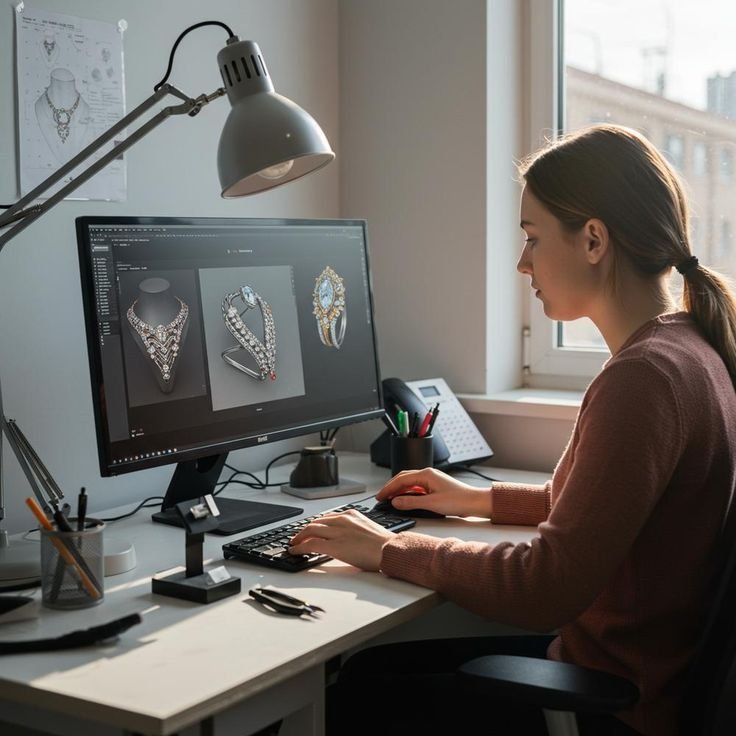
Artificial intelligence is changing how creative industries approach design, and jewellery is no exception. From generating design concepts to visualizing intricate patterns and exploring different gemstone combinations, AI-powered tools are giving jewellery designers new ways to experiment and develop ideas. Today, AI in jewellery design is helping designers explore some of these stages more efficiently while opening new possibilities for customization and innovation.
Traditionally, jewellery creation involves several stages, including inspiration, sketching, material selection, design development, and prototyping. These processes require creativity as well as technical knowledge of metals, gemstones, proportions, and manufacturing methods.
For jewellery design students and professionals, understanding this technology is becoming increasingly useful. However, AI does not replace the artistic judgment, craftsmanship, and material expertise required to create wearable jewellery. Instead, it can support the creative process when used thoughtfully.
This article explores how AI is transforming jewellery creation, its key applications, benefits, limitations, and practical ways students can begin using AI in their design workflow.
What Is AI in Jewellery Design?
AI in jewellery design refers to the use of artificial intelligence technologies to support the development, visualization, and refinement of jewellery concepts. These tools can analyze prompts, references, shapes, and design requirements to generate visual ideas or assist with certain design tasks.
For example, a jewellery designer can describe a concept for a contemporary gold necklace featuring floral patterns and gemstone details. An AI image-generation tool may produce several visual interpretations that can serve as starting points for further development.
AI-powered design workflows can also support pattern exploration, personalized design concepts, image enhancement, and product visualization.
However, an AI-generated image is not automatically a production-ready jewellery design. Technical drawings, accurate dimensions, material specifications, stone settings, and manufacturing feasibility still require human expertise and appropriate design tools.
AI-Powered Jewellery Concept Generation
One of the most visible applications of AI in jewellery creation is concept generation. Designers can use text prompts, reference images, and visual inputs to explore multiple creative directions.
How It Works
A designer provides an AI tool with a description of the desired jewellery piece. The prompt may include:
- Jewellery type, such as rings, necklaces, earrings, or bracelets.
- Preferred metal, such as gold, silver, or platinum.
- Gemstone choices and color combinations.
- Design inspiration, such as nature, architecture, or traditional motifs.
- Desired style, such as minimalist, vintage, or contemporary.
The tool generates visual concepts based on these instructions. Designers can compare the results, identify useful details, and refine their preferred direction.
This can be particularly helpful during the early brainstorming stage, when exploring different ideas manually may take considerable time.
Generative AI for Innovative Jewellery Designs
Generative AI can create new visual variations based on user instructions and reference material. It allows designers to experiment with shapes, textures, patterns, and decorative elements.
For example, a designer developing a nature-inspired collection can explore leaf-shaped pendants, floral motifs, organic curves, and geometric interpretations of natural forms.
Supporting Creative Experimentation
Generative AI can help designers:
- Explore multiple design concepts quickly.
- Experiment with unusual shapes and patterns.
- Compare traditional and modern styles.
- Develop inspiration boards for jewellery collections.
- Visualize different gemstone and metal combinations.
The generated concepts should be treated as creative references rather than final designs. Designers need to refine proportions, construction details, and material choices before moving towards production.
AI and 3D Jewellery Design Visualization
Three-dimensional visualization helps designers understand how a jewellery piece may appear from different angles. AI-assisted workflows can support image generation and visual exploration, while specialized 3D jewellery tools and software are used to develop more precise digital models.
Why 3D Visualization Matters
A flat jewellery sketch may not fully communicate the depth, proportions, stone placement, or structure of a jewellery piece. A 3D model provides a clearer view of these details.
Designers can use digital modeling tools to explore:
- Ring shapes and band proportions.
- Pendant structures and necklace arrangements.
- Gemstone placement and setting concepts.
- Surface textures and decorative details.
- Different metal finishes and color combinations.
It is important to understand the difference between AI-generated 3D-looking images and technically accurate 3D CAD models. The latter are more suitable for measurement, design refinement, and manufacturing preparation.
Personalized Jewellery Design and Customer Preferences
Customers increasingly look for jewellery that reflects their personal style, special occasions, and individual preferences. AI can help businesses explore customized design options based on customer inputs.
For example, a customer may want a personalized engagement ring with a particular gemstone, metal color, setting style, and engraving. AI-assisted concept generation can help visualize different combinations before a final design is selected.
Benefits of AI-Based Customization
- Faster exploration of design variations.
- Better visual communication with customers.
- More personalized concept presentations.
- Easier comparison of styles and materials.
- Support for customized collections.
However, customer preferences should be confirmed before production. A visual concept must be translated into accurate specifications and checked for comfort, durability, stone security, and manufacturing requirements.
AI for Jewellery Trend Research and Collection Planning
Jewellery designers need to understand changing customer preferences, popular styles, and emerging design directions. AI tools can assist with organizing research, summarizing information, and exploring visual themes.
For example, designers developing a festive jewellery collection may research traditional motifs, color combinations, gemstone styles, and contemporary interpretations of Indian jewellery.
AI can help organize these references into mood boards and concept directions. However, designers should verify trend information using reliable fashion publications, jewellery exhibitions, market observations, and customer feedback.
Relying entirely on AI-generated trend suggestions can lead to repetitive or generic collections. Original research and a clear understanding of the target audience remain important.
Benefits of Using AI in Jewellery Design
AI offers several advantages when integrated into a designer’s creative workflow.
1. Faster Concept Development
AI can generate multiple visual ideas from a single prompt, helping designers explore possibilities during the initial development stage.
2. Greater Creative Exploration
Designers can experiment with styles, motifs, and combinations that they may not have considered initially.
3. Improved Customer Presentations
Visual concepts can help customers understand a proposed design before detailed development begins.
4. Support for Small Jewellery Businesses
Independent designers and smaller businesses can use accessible AI tools to explore collection ideas and prepare initial visual presentations.
5. More Efficient Design Communication
AI-generated references can help designers communicate visual direction to clients, collaborators, and production teams, provided that technical specifications are developed separately.
How Jewellery Design Students Can Start Learning AI Tools
Students do not need advanced technical knowledge to begin exploring AI-assisted jewellery design. They can start with simple creative exercises and gradually combine AI tools with traditional design techniques.
- Learn jewellery fundamentals: Understand gemstones, metals, shapes, proportions, and basic jewellery construction.
- Explore AI image tools: Experiment with prompts for rings, earrings, pendants, and necklaces.
- Create mood boards: Use generated concepts alongside real design references and material samples.
- Practise traditional sketching: Convert selected AI concepts into hand-drawn jewellery illustrations.
- Learn digital design software: Explore suitable 2D and 3D tools for technical development.
- Evaluate design feasibility: Check whether the concept can be produced with suitable materials and construction methods.
- Build a design portfolio: Build a jewellery design portfolio that showcases the original concept, AI-assisted exploration, refined sketches, and final design development.
Combining digital experimentation with practical learning can help students develop a balanced understanding of modern jewellery creation.
Conclusion
AI is introducing new possibilities in jewellery creation by helping designers explore concepts, experiment with visual styles, and communicate ideas more effectively. From generative design to personalizing jewellery concepts, these tools can support several stages of the creative process.
However, technology works best when combined with traditional design knowledge and practical skills. Understanding gemstones, metals, proportions, technical drawings, and craftsmanship remains essential for turning an attractive visual concept into a wearable jewellery piece.
For aspiring designers, learning both traditional techniques and modern digital tools can provide a valuable foundation for adapting to the changing jewellery industry.
Frequently Asked Questions
1. How is AI used in jewellery design?
AI generates design concepts, explores patterns, visualizes jewellery styles, creates mood board references, and supports personalized design presentations.
2. Can AI create jewellery designs from text prompts?
Yes. Generative AI tools can create visual jewellery concepts from written descriptions. However, these images generally need further refinement before they can be used for manufacturing.
3. Will AI replace jewellery designers?
AI is unlikely to replace the complete role of jewellery designers. Creativity, gemstone knowledge, material selection, technical accuracy, craftsmanship, and customer understanding remain important human skills.
4. Which skills should jewellery design students learn alongside AI?
Students should learn jewellery illustration, gemstone knowledge, metal properties, design development, technical drawing, and digital jewellery design. These skills help them evaluate and refine AI-generated concepts.
5. Is AI useful for starting a jewellery business?
AI can help new jewellery businesses explore collection concepts, create initial visual presentations, and communicate customization ideas. However, production planning, material sourcing, quality control, and technical design still require proper expertise.
Explore Jewellery Design Skills at IFJD
Build your creative foundation with practical knowledge of jewellery concepts, materials, and design development. IFJD offers jewellery design education to help students develop their creative and technical abilities. Explore the jewellery design course at IFJD to learn more about the course and take the next step towards a career in jewellery design.